
SmallSat 2026: Poster Session
“Adapting Missions not Machines: Extending On-Orbit Operations to Maximize ROI”
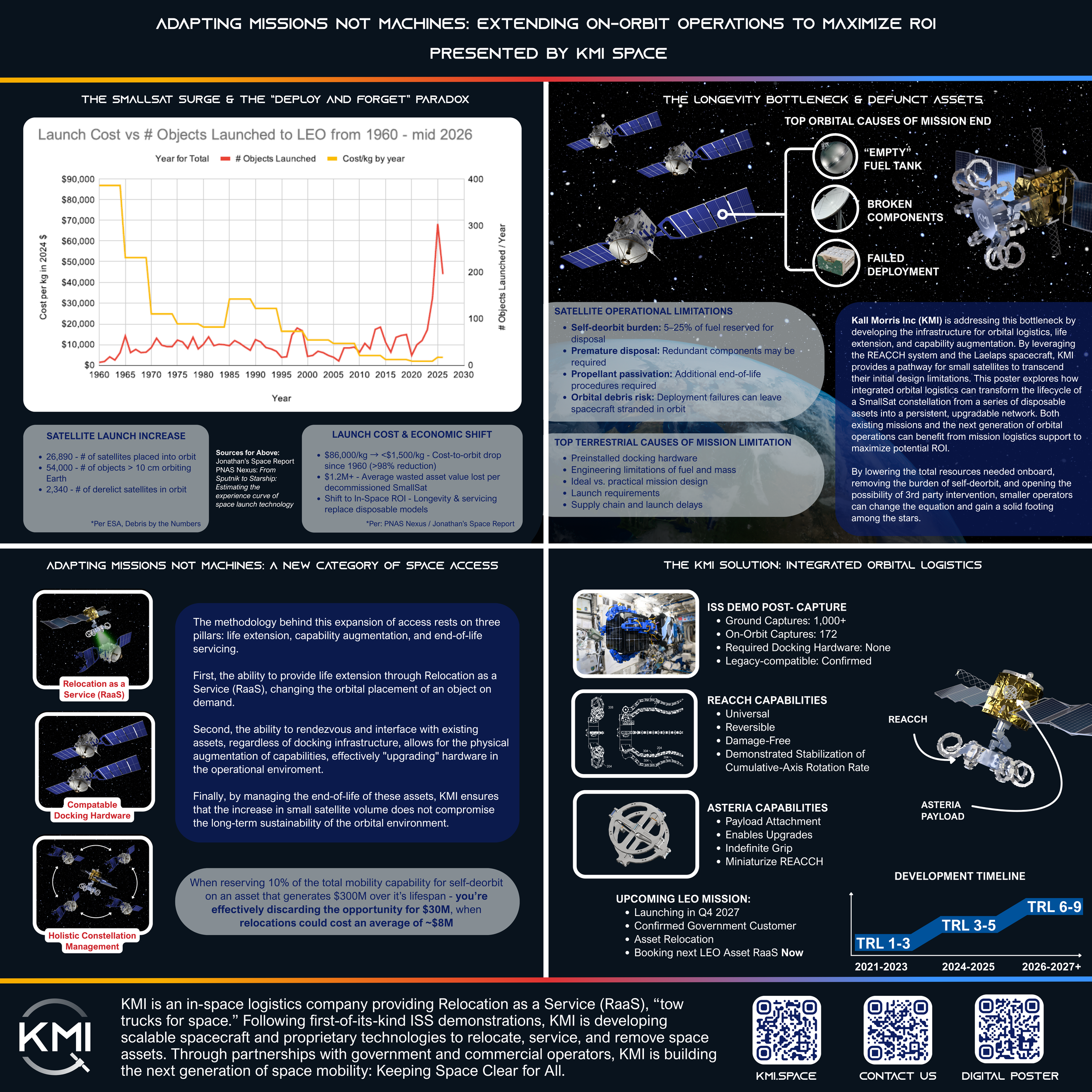
The rapid evolution of the launch industry has fundamentally lowered the barrier to entry for space access. Through multi-manifest launches and dedicated rideshare opportunities, small satellites have moved from secondary payloads to primary drivers of orbital commerce and scientific discovery. However, the current paradigm of space access remains limited by a "deploy and forget" philosophy. Once a small satellite exhausts its onboard resources, propellant, or faces a component failure, its mission ends, regardless of the remaining utility of its primary payload. To truly unlock the potential of the next generation of spacecraft, the industry must transition from focusing solely on launch access to focusing on operational access and longevity.
Kall Morris Inc (KMI) is addressing this bottleneck by developing the infrastructure for orbital logistics, life extension, and capability augmentation. By leveraging the REACCH system and the Laelaps spacecraft, KMI provides a pathway for small satellites to transcend their initial design limitations. KMI explores how integrated orbital logistics can transform the lifecycle of a SmallSat constellation from a series of disposable assets into a persistent, upgradable network. Both existing missions and the next generation of orbital operations can benefit from mission logistics support to maximize potential ROI. By lowering the total resources needed onboard, removing the burden of self-deorbit, and opening the possibility of 3rd party intervention, smaller operators can change the equation and gain a solid footing among the stars.
The methodology behind this expansion of access rests on three pillars: life extension, capability augmentation, and end-of-life servicing. First, the ability to provide life extension through Relocation as a Service (RaaS), changing the orbital placement of an object on demand. Second, the ability to rendezvous and interface with existing assets, regardless of docking infrastructure, allows for the physical augmentation of capabilities, effectively "upgrading" hardware in situ. Finally, by managing the end-of-life of these assets, KMI ensures that the increase in small satellite volume does not compromise the long-term sustainability of the orbital environment.
By shifting the focus from the launch pad to the orbital plane, KMI is creating a new category of space access. This approach allows developers to launch smaller, more specialized craft with the confidence that their mission duration and utility are no longer tethered to their launch mass. In doing so, we move toward an orbital economy where access is defined not just by the ability to reach orbit, but by the ability to thrive, adapt, and persist within it.