
Making Moves in Space
Making Moves in Space
Troy M. Morris, Co-Founder & CEO
4 minute read
KMI Space has been awarded a Strategic Funding Increase (STRATFI) through the United States government: a contract supporting years of upcoming progress as the result and continuation of many years’ hard work by our team and others. While the details of the first STRATFI announcement and our upcoming specific announcement will cover the available details, this column attempts to cover some of the context that might otherwise be lost.
To begin properly framing where the industry is at, let’s start with the wonderful conundrum that the successes in space are becoming their own problem, and the limitations must be solved for increased access, achievement, and overall outcomes: to-, through-, and from- space. For the “why space” assumption, I and others continue to write and speak about the importance of space for understanding the origins of life, mapping a path through the future, and the immediate value of communication and information. Whether you value space for majestic, existential, or practical benefits, the restrictions of available mobility and maintenance in space constrain humanity’s best efforts to the Tyranny of the Rocket Equation. Whether perceived from the limits of launch, managed mitigation of operational assets, hazards of increasing space debris, or advancing to greater assembly and manufacturing in space, the various questions come to a similar answer - the modern world and the required in-space infrastructure need access, extension, and innovations made possible by advanced maneuvering and asset relocation.
The grand achievement of an idea, and the inspiration behind it, are related elements that often occur years apart. A famous example is Albert Einstein’s annus mirabilis in 1905, with his general theory of relativity proposed in 1915. Near similar in time and an ocean away, Robert Goddard patented multi-stage and liquid-fuel rockets in 1914, with the revolutionary launch occurring in 1926. While I may personally attest to the similar potential of my co-founders against the establishing geniuses of advanced physics and aerospace engineering, my comparison is more intended to illustrate the time it takes to prove transformative ideas versus their public release of the concept.
In 2014, I met Adam Kall at Northern Michigan University as the randomly assigned freshman-year suitemate to my brother Austin Morris, where we three shared many ideas, dreams, and concepts that would lead to co-founding Kall Morris Incorporated (KMI Space) more than half a decade later. In 2026, KMI Space was publicly announced for our U.S. Space Force (USSF) Strategic Funding Increase (STRATFI). After a hundred years of rocketry, and the majority of it including fantastic expansions of spaceflight in awe-inspiring avenues, since Einstein and Goddard changed the world, KMI is seeking to transform the in-orbit industry and ecosystem of operations through our coming demonstrations.
As the first operational component of our developing Relocation as a Service (RaaS) model, this STRATFI-supported mission will develop, integrate, and operate a radically optimized spacecraft to rendezvous, retrieve, and relocate multiple satellites in orbit. This maneuvering platform, designated “Laelaps” (a Greek mythological hound that caught everything it chased in the Legend of Laelaps), will host efficient systems for grapple, docking, and movement in orbit. The highlight of these many partnered and flight-proven systems is our own ISS-demonstrated end effector: REACCH.
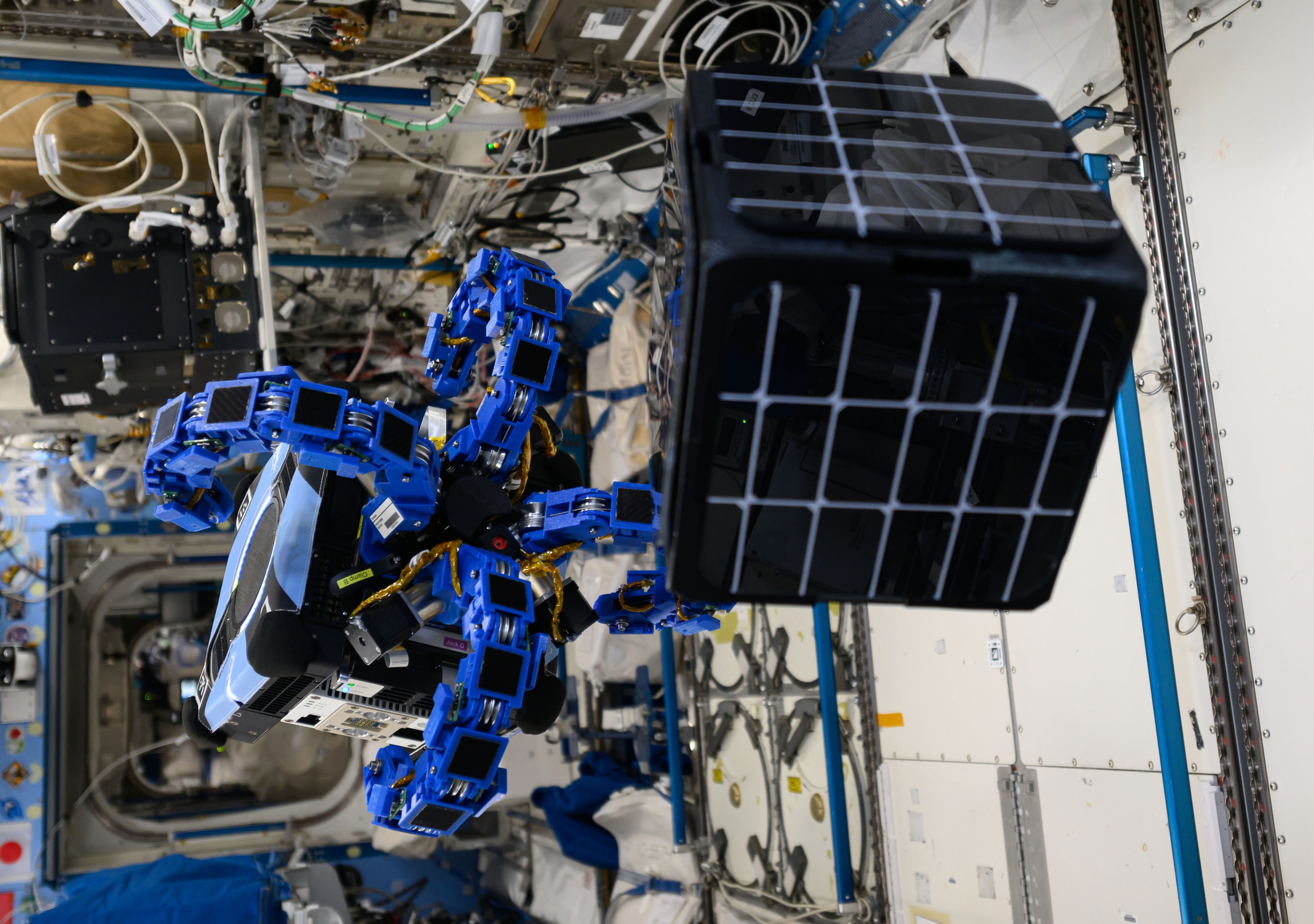
REACCH testing on the ISS (KMI Space)

Urania’s Mirror depicting Canis Major (Laelaps) and the neighboring constellation Lepus (the Hare) (Sidney Hall)
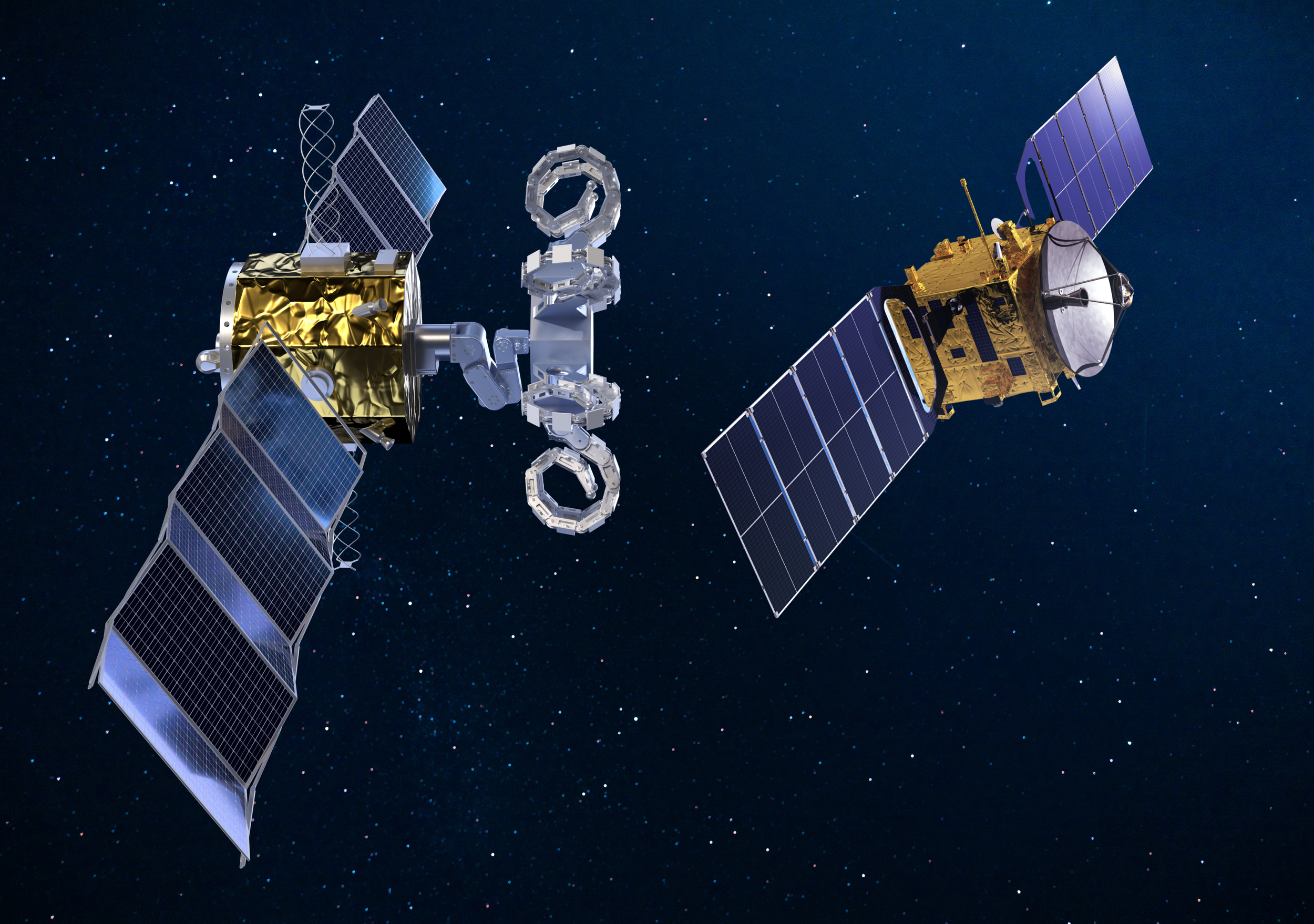
Laelaps spacecraft approaching a satellite (KMI Space)
All of these technological innovations and capabilities are to complete a challenging task: catch and change the trajectory of orbital objects. But what this unlocks is a revolutionary unshackling of constraints that have been requirements as long as humanity has aimed rockets into orbit. Through the efficient external relocation of assets by a dedicated servicer like the KMI Laelaps, satellites going forward can reduce or even remove their own mobility systems. Not just for end-of-life deorbiting, but for almost any and all movements in orbit. Imminent examples exist, such as an imaging satellite could be redeployed to cover an area experiencing a disaster. A high-altitude communication satellite could be lowered to provide connectivity in new ways not originally designed. Or any number of new models could spring into existence as the benefits of satellites with less mass, complexity, and cost arrive in the ever-more competitive commercial marketplace of orbit.
The coming age of in-space access and logistics is merely catching up to the status quo of support we see on the ground, similar to modern cars carrying just a subset of the extra tools and tires first deployed on the rugged world, or the business traveler trusting just a carry-on compared to a deepwoods hiker. When more options and opportunities are available as a service to those in motion (by plane, train, automobile, or soon: launch vehicle), usage increases with commerce, often with falling costs due to the scale, success, and competition possible in an economy, not just a singular enterprise.
This is the state we at KMI see the world of aerospace entering, an existence beyond requiring each satellite to design, order, integrate, test, and operate systems far beyond their manifested missions. For comparison, how many modern drivers buy a new vehicle when theirs has an issue, rather than schedule servicing? It is a dynamic, dependable infrastructure from many expert providers that makes the modern world possible, with an utmost requirement of resiliency for such an ecosystem in space. Grand visions supporting existing and future satellites are one of the last occurrences to come as we pass technical and business metrics along the way, but it’s also one of the most exciting and it drives much of the given energy applied to the STRATFI program at KMI.
As I’ve been dreaming of space activities since childhood, my hope for our current and future generations is that we’re able to realize this next age, not just of “tow trucks in space” but true “shipwrights in space,” far quicker than the century it took from Goddard’s launch to get to today. KMI Space is actively taking our position for increasing options and opportunities in orbit, and we look forward to long and new partnerships that develop in this role of unlocking some of the fixed constraints of space. STRATFI is an important milestone for KMI, but the larger opportunity is building the infrastructure that will allow spacecraft to be mobile, manageable, and sustainable throughout and beyond the planned operations in orbit and in space beyond.
Recommended column to read next: Little Scientists’ Queries
