
Little Scientists’ Queries
Little Scientists’ Queries
Rose Schopfer, Software Developer and Educational Outreach Enthusiast
7 minute read
Soon, school hallways will be buzzing with kids working toward their futures. Here at KMI, we value young minds and everything they bring to the table: fresh perspectives, new ideas, and slang that we millennials here at KMI mostly cannot keep up with. Before the last school year wrapped up, Adam Kall and I drove out to the NICE Community School District to share what KMI does and why we do it with several fifth-grade classes. Afterward, the kids asked a plethora of questions! The most popular query was definitely: "What would happen if you put [an animal] out in space?"
If you are also wondering what happens to animals in space, here is the most PG answer we could give on the spot. Inside the International Space Station (ISS), most animals panic because gravity has been turned off, and they need gravity for balance. If you ask what happens to them outside the space station, more specifically in the vacuum of space, the answer is a bit anticlimactic: they would die. I am skipping details that curious minds might want on purpose; I will leave that science-based discussion between you, your parents, and your science teachers. Or maybe this other KMI Column: The First Space Travelers.
I suspect kids think organic material in space explodes due to bad science in movies. If you want something dramatic and explosive, check out supernovae instead. They are much more beautiful and dramatic by nature.
Now let us look at what these bright young minds wanted to know outside of putting zoo animals in the vacuum of space. Also, does anyone know if PETA keeps a watchlist?
How long has it taken your team to get as far as you are on the project?
Asked by Megan
The majority of our team came together in late 2022, which represents about three and a half years of effort so far! It has been an exciting journey, and our team is thrilled for what the next few years will bring.
When and why was KMI started?
Asked by Kroy
First, I’ll share what Adam had to say in response directly: “The cofounders started the company in 2019 after reading a 1980 NASA report stating space debris would become a critical problem in forty years. We realized that prediction had come true and action was required. There is a saying: "The best time to plant a tree was twenty years ago. The second best time is right now." KMI’s cofounders decided to create the solution that should have been built decades ago.”
I’ll build off of that by saying the KMI team is also here because we love the Upper Peninsula of Michigan. Our founders attended Northern Michigan University here in Marquette and then went off to tackle the world in different cities. After a few years in the normal hustle and bustle of adult life, they realized they wanted to return to Marquette, but there wasn’t an opportunity here for the kind of work they wanted to do. They decided to make their own opportunity and sat down to brainstorm all the problems they could solve. Specifically, the problems in space, of course. One issue blocked them from almost every other fun idea: space debris. So they started KMI right here in Marquette to build a new industry locally while solving a problem they were passionate about. Resilience is required in our field, and our passion fuels it every day.
When do you plan on launching Laelaps? What would happen if the largest piece of space debris hit the moon?
Asked by Liam
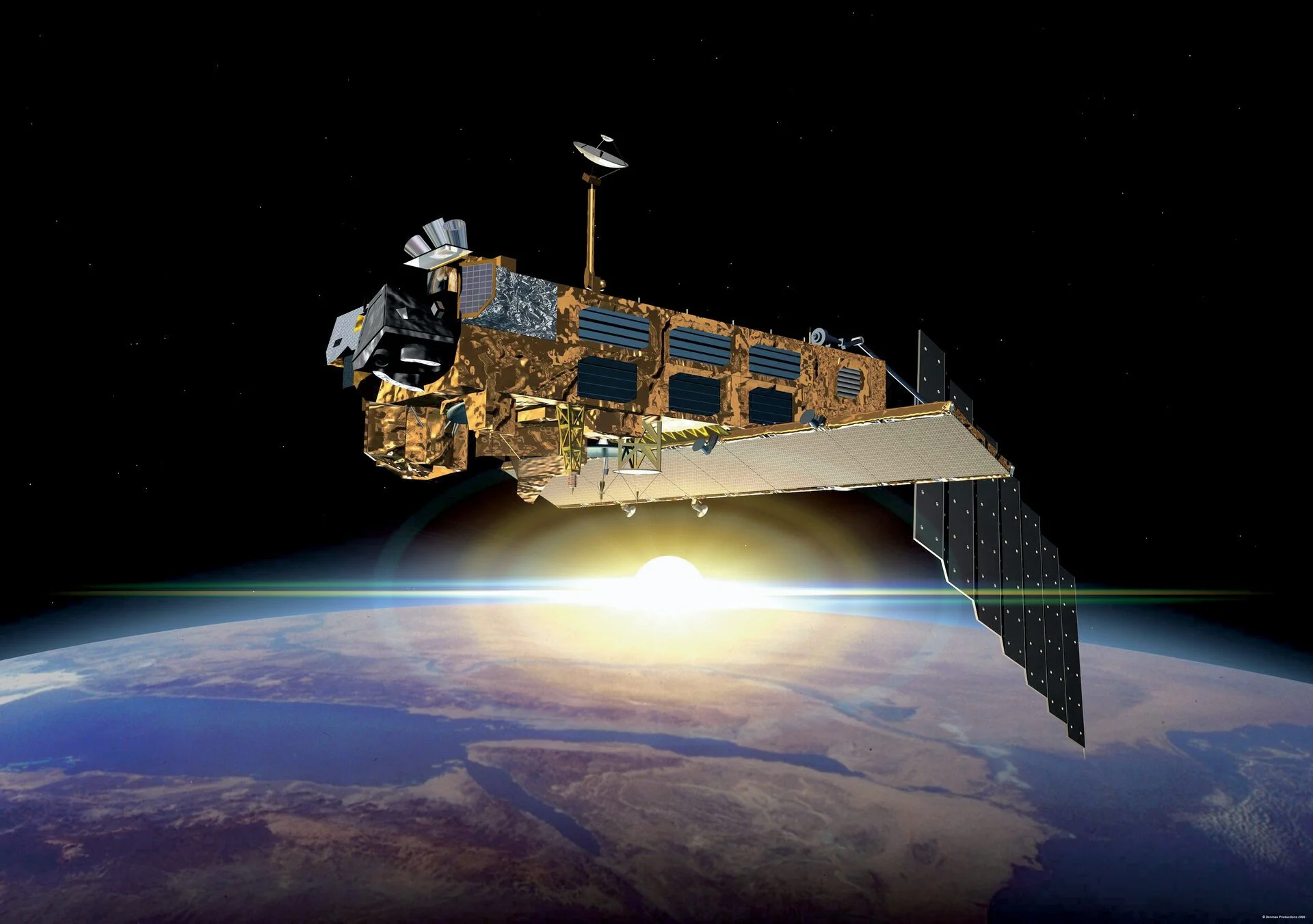
Envisat (ESA)
We are aiming to launch Laelaps sometime in 2028! It is very exciting, and KMI will be extremely busy preparing for this massive next step.
To answer your next question, Envisat is currently the largest piece of space debris. It was the most powerful European Earth observation satellite ever built, but it has been inactive since 2012. For comparison, Envisat is about the size of a blue whale. The moon is vastly larger. In fact, it would take about 300 billion blue whales to cover the surface area of the moon! If Envisat collided with the moon, the moon would barely notice, though Envisat would have a very bad day. Remember, asteroids hit the moon all the time, which is how we got all those cool lunar craters!
Can Earth's gravity pull space debris back in? What would happen if it did? What would happen to a tree in space?
Asked by Benny
Benny, I like the way you think. These are fantastic questions that led me down several rabbit holes.
First, let us reshape how we think about gravity. On Earth, we usually think about gravity the way Newton did: a force pulling things straight down. But when Einstein came along, he expanded on that concept. Einstein redefined gravity as the curvature of space and time itself. It sounds complicated, but picture gravity in space like a giant funnel. Rather than being pulled “straight down” by an invisible force, objects affected by gravity are simply being pulled into that funnel. After all, what way is down in space?
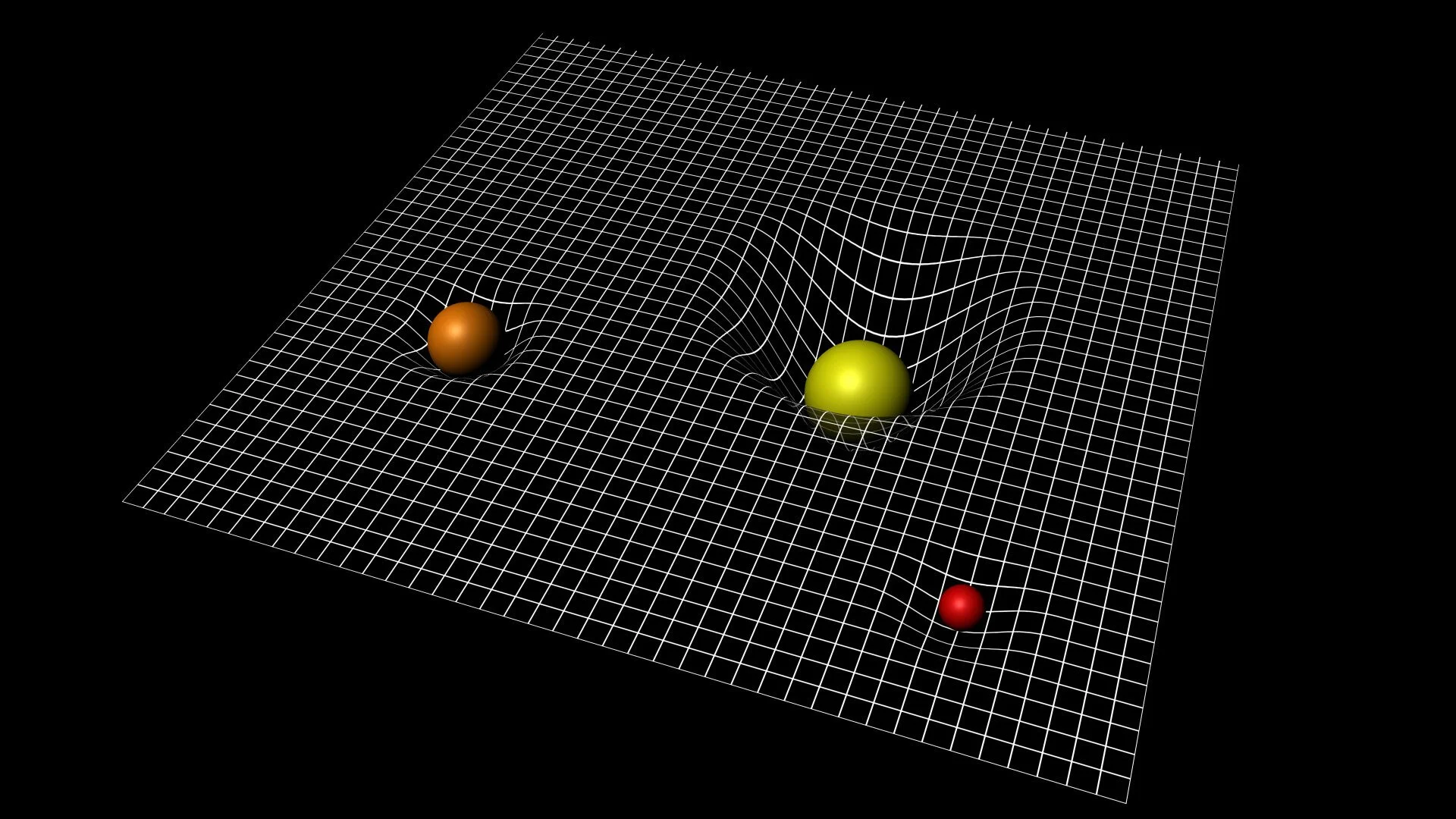
Spacetime curvature (ESA)
Here is a quick thought experiment; Einstein really liked these: imagine you are floating endlessly in the empty void of space. Let's even turn the stars off for good measure. With no landmarks to guide you (what physicists call a frame of reference) and no change in your speed, you wouldn't be able to tell if you were moving at all. After all, we only feel acceleration, not smooth, constant motion. Are you moving up? Down? Zigzagging across the universe? Gravity in space does not know which way is “down” either! A fun way to picture gravity is a trampoline. Earth is a heavy bowling ball sitting in the middle. Satellites are like marbles rolling around the curve created by that bowling ball.
Satellites orbit Earth because of this curvature. Over time, we can make plans for them to fall back toward Earth, a process called deorbiting or orbital decay. Whether a satellite computer is turned on or off does not matter. It will orbit as long as it stays on that curve. If debris falls back into our atmosphere, it burns up safely on reentry!
Now for my absolute favorite question, which sent me down a total research rabbit hole: what happens to a tree in space? I had never considered this before! It almost makes me want to strap a pine tree to a rocket, though launch heat would burn it up instantly.
Interestingly, JAXA (Japan's space agency) launched a wooden satellite named LingoSat in 2024. LingoSat is a small cube measuring 10 cm by 10 cm by 10 cm. It stayed in space for about four months and proved wood could handle the extreme temperature swings of space orbit.
Now, what if you threw a whole tree into deep space? Here is my hypothesis, and in student terms: please, nobody flame me if I am wrong! Science is all about testing ideas. Let us establish two assumptions:
The tree is pulled directly from Earth and tossed into space, meaning it still has water, sap, and full moisture inside.
We are placing the tree in deep, desolate space where it is freezing cold.
What happens? The tree gets very cold, very fast. It freezes solid. The sap and moisture inside freeze too. The wood splinters, shrivels, warps and becomes extremely brittle. Long story short, you have created the world's first giant raisin tree. Congratulations! You are a true scientist for going on this journey with me.
Another incredible fact I found while researching: scientists once placed moss on the outside of the space station, and it survived nine full months in the vacuum of space!
What is the average speed space debris travels at? What is the fastest object right now?
Asked by Caleb

Animation showing the motion of an elliptic orbit (Brandir)
Space debris must move fast to stay in orbit. Average speed is tricky to define because closer objects must travel faster to stay up. Going back to our gravity funnel from Benny’s question, the closer you are to the bottom, the faster you must move so gravity does not pull you down. The fastest orbital debris travels is around 17,500 miles per hour! If it speeds up, it shifts into a higher, stretched-out path called an elliptical orbit until it slows down again.
As for the fastest overall manmade object, that title goes to the Parker Solar Probe. Parker is traveling to study the sun. Because the sun is huge and has immense gravity, Parker reaches speeds over 400,000 miles per hour! At that speed, you could fly from New York to San Francisco in just 26 seconds.
What will you do with space debris once you capture it?
Asked by Gatsby
Great question, Gatsby! We get asked this a lot, and it is a fun topic to explore. Right now, there are two main phases:
Phase 1: Capturing space debris using specialized capture mechanisms, like our space octopus, REACCH, is brand new territory. Because this industry is so young, our best current option is guiding captured debris back down toward Earth so it safely burns up in the atmosphere.
Phase 2: As technology matures, we can build orbital stations to collect captured debris. From there, we can repair inactive satellites or recycle their materials! Satellites are expensive largely because of their specialized metals, so recycling them will make space exploration far more sustainable.
How big will Laelaps be once built?
Asked by Giovanni

Golden Retriever sitting on hind legs (Barnabas Davoti)
Laelaps will be about four feet wide, roughly the height of a fifth grader! We only need a compact spacecraft to move large debris thanks to the specialized gecko adhesion technology we use. Here are a few fun size comparisons for four feet:
Two school desks pushed together
A standard bathtub
A golden retriever standing on its hind legs
Wrapping Up
That completes our questions from the fantastic fifth graders at NICE!
I loved answering these. It is so important to build spaces where curiosity is celebrated. As a new school year begins, I encourage every student reading to chase your passions. Your future is not limited by any obstacle in your path. Our team at KMI is cheering you on! And if a scientist ever actually launches a tree into space, I will definitely be thinking of this group.
To any parents, guardians, or adults who enjoyed reading this: please keep encouraging the young dreamers in your life. I still remember everyone who told me I could succeed when I had my own doubts. This generation of kids will remember your encouragement too.
Recommended column to read next: KMI: The Origin Story, Part II