
The Celestial Silk Road
The Celestial Silk Road
Preksha Sanjay Madhva, Robotics Engineer
3 minute read
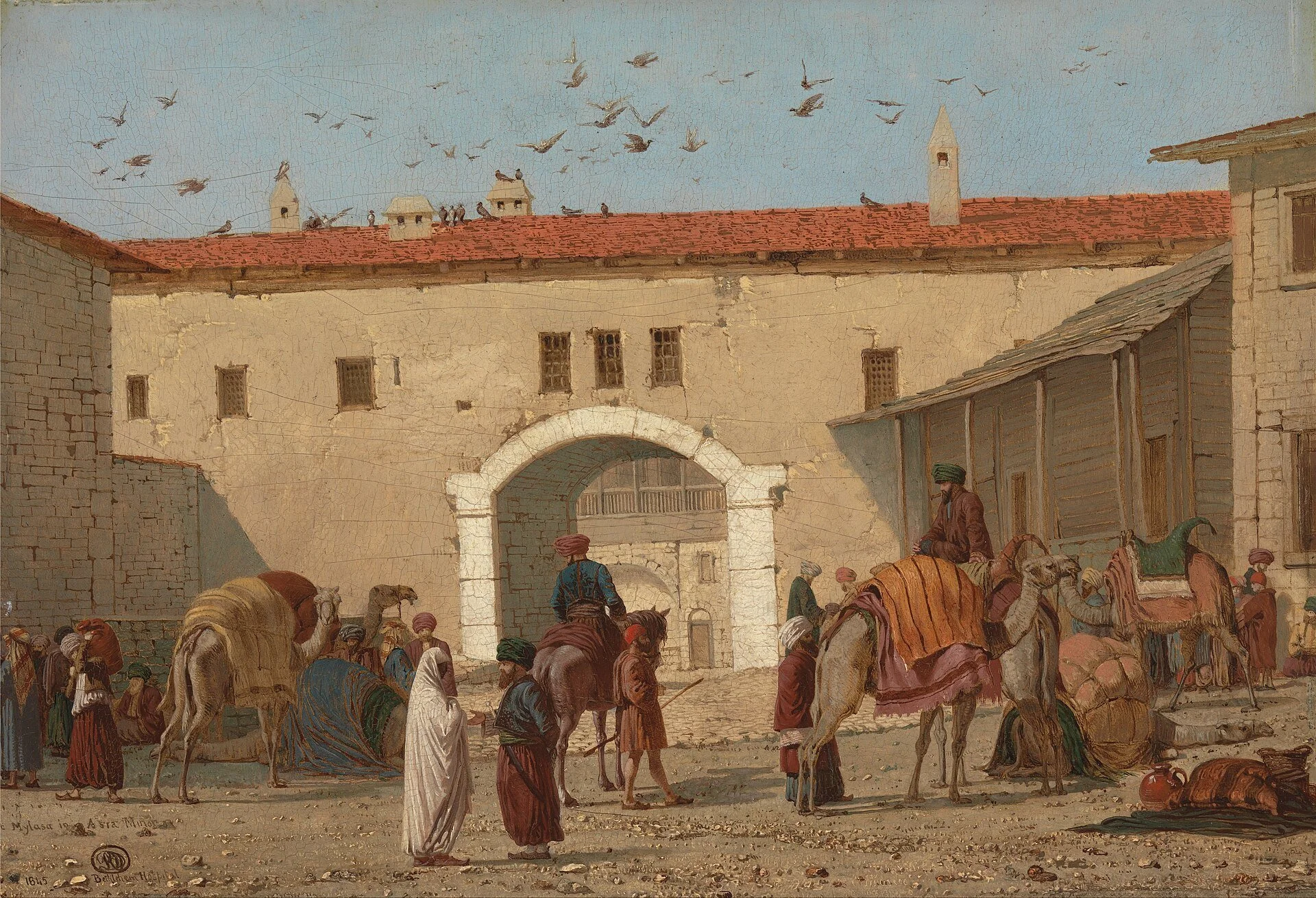
Caravanserai at Mylasa in Asia Minor (Richard Dadd)
There is something unbearably romantic about the moment a new trade route opens. From the Age of Discovery, the Amber Road, and most famously the Silk Road, history remembers their beginnings not as mere points on a timeline, but as the first spring rains that allowed for new growth and life. The world suddenly seemed larger, its treasures brought closer, and beyond mere silk or jade, these routes represented an exchange of knowledge and culture, stitching together the hemispheres one arduous mile at a time. When the ancient Silk Road wound its way across the deserts and mountains of Asia, it was not a single paved lane, but rather a sprawling adaptive network of oases, market towns, and caravanserais (travellers’ rest stops). The genius of the road was its collectiveness; it never belonged to any one empire but rather was held together with the shared unspoken understanding that the flow of resources, knowledge, and innovative ideas benefited the village as much as the throne. As we look toward the future, we are on the cusp of creating an entirely new journey. Now, instead of the Taklamakan desert, it is across the silent paths between the Earth and the Moon. Rather than spices or textiles, we will have Helium-3 for fusion, platinum-group metals, and perhaps even space-manufactured pharmaceuticals as the commonly traded goods. The Celestial Silk Road promises to be the most inclusive and prosperous economic corridor humanity has ever built, where fortunes are made by both private and public ventures.
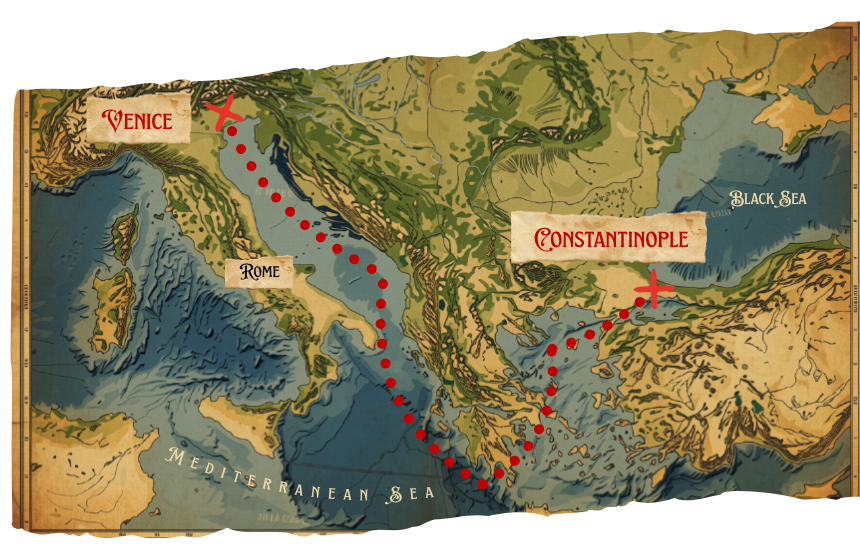
Venice to Constantinople (KMI)
For decades, space travel was a forced march: we launched rockets and satellites, used them until the fuel ran dry, and then left them as driftwood on the infinite ocean or, even worse, as treacherous rocks or icebergs making the path more hazardous for the ships that came after. This is the equivalent of building a ship in Venice, then sailing it to Constantinople, only to burn it for firewood upon arrival. The brutal economics of one-way voyages are the model for kings, not merchants. But that logic will invert completely over the next 50 years by moving from an era of expedition to an era of logistics, and the foundations of the Celestial Silk Road will be the humble but revolutionary act of staying.
The first and most vital caravanserai of this new domain are orbital refueling depots. We see the first sparks of this in the testing of cryogenic fuel transfer in microgravity. When this fuel can be stored in space, similar to grain in silos, spacecraft will no longer need to claw their way out of Earth’s gravity while carrying their entire journey’s weight. For smaller nations with nascent space agencies, this is a revolution in equity, by lowering the admission cost to participate in this lunar economy to competent tugboats rather than rockets the size of skyscrapers. If depots are oases, then orbital skyhooks would be the trade winds to carry spacecraft between them; massive rotating tethers that act as momentum exchange elevators and allow travel between the various waystations and orbits at a fraction of the propellant cost.
The foundations are already being laid today, with civil space traffic coordination systems preparing to warn all spacecraft of collision hazards, regardless of flag of origin. Private and civilian contractors like KMI are tackling the ever-growing orbital debris problem and will keep space clear for all. Finally when orbital recycling plants begin accepting debris to provide the feedstock for in-orbit repair and manufacturing operations, they’ll also take on the role of shipyards, becoming the center of a vibrant ecosystem.


Silver Drachm Coin, 590 CE (Classical Numismatic Group)
This is the alchemy of the Celestial Silk Road. The road does not need to be owned; it only needs to be made safe, standardized, and open. The vision for America's future in the space sector shouldn’t be a fortress or a lonely citadel; it should be a bustling, cluttered, and international spaceport, operating loudly with the hum of in-situ resource utilization plants turning lunar regolith into water and mining asteroids far beyond the horizon. In this environment, currency will go beyond the Byzantine gold coinage and silver drachms of old; replaced with data and energy as the new currencies of trade. Instead of standardized weights and measures, there will be standardized docking ports, fuel valves, and data protocols. International regulations and laws on ownership and liability are being drafted today for use in tomorrow’s space economy. Reusable rockets are already flying, with microgravity fuel transfers and skyhooks in testing, and the first capture demonstrations of unprepared space objects are imminent. When we look back from the vantage point of 50 years from today, we will see that the greatest legacy of this era was not a flag planted in lunar regolith, but the invisible architecture and cooperation that made the Celestial Silk Road not just possible but prosperous, and open to all who wished to travel into starry seas.
Recommended columns to read next: Intentional Design for a Sustainable Future