
Since REACCH Returned
Since REACCH Returned
Austin Morris, Co-Founder & CTO
8 minute read

The successful and triumphant conclusion of the KMI REACCH demonstrations, one of the coolest things I’ve ever done in my life (so far), was bookmarked by disembarking from the International Space Station (ISS) on May 23, 2025, and safely splashing down off the California coast at 1:44 am on May 25, 2025, aboard SpX-32. At the time of this writing, it has been nearly a year since REACCH returned from the ISS, marking a good time to reflect upon the prototype-littered road so far.
As with many stories, it’s best to start this one at the beginning, with the origins of REACCH. Originally developed on a DARPA-sponsored project, executed by teams at the University of Southern California and NASA Jet Propulsion Laboratory, the REACCH concept was originally spawned from the brilliant mind of David Barnhart. The technology was developed for a couple of years, but eventually, several students graduated, funding was reallocated, and, as happens with an unfortunately large number of interesting science projects, REACCH was put on a shelf to collect dust.

REACCH Patented Hardware (Patent: US11661217B2)
Nearly two years later, in the midst of a global pandemic, Dave delivered some very interesting and progressive perspectives on developments in the space industry during a virtual panel that was being watched by a young twenty-something who had just started a company together with his younger brother and their mutual friend. Troy M. Morris reached out to Dave after the webinar to request a further conversation and to introduce his co-founders, Adam Kall and me. While having an interesting introductory discussion, at some point, Dave leaned back in his chair, coincidentally letting us all see the shelving unit behind him, on which an amalgamation of robotic-looking tentacles was resting. With an unending curiosity, my co-founders and I all jumped to ask about them, and Dave was happy to share. He told us the origins, the intention of the technology, and how sad he was that it was now sitting with nobody to carry it forward and continue development. My eyes widened at the prospect, and (now I get to use that handwavy author’s tool to avoid continuing at this level of detail and instead say) the rest is history.
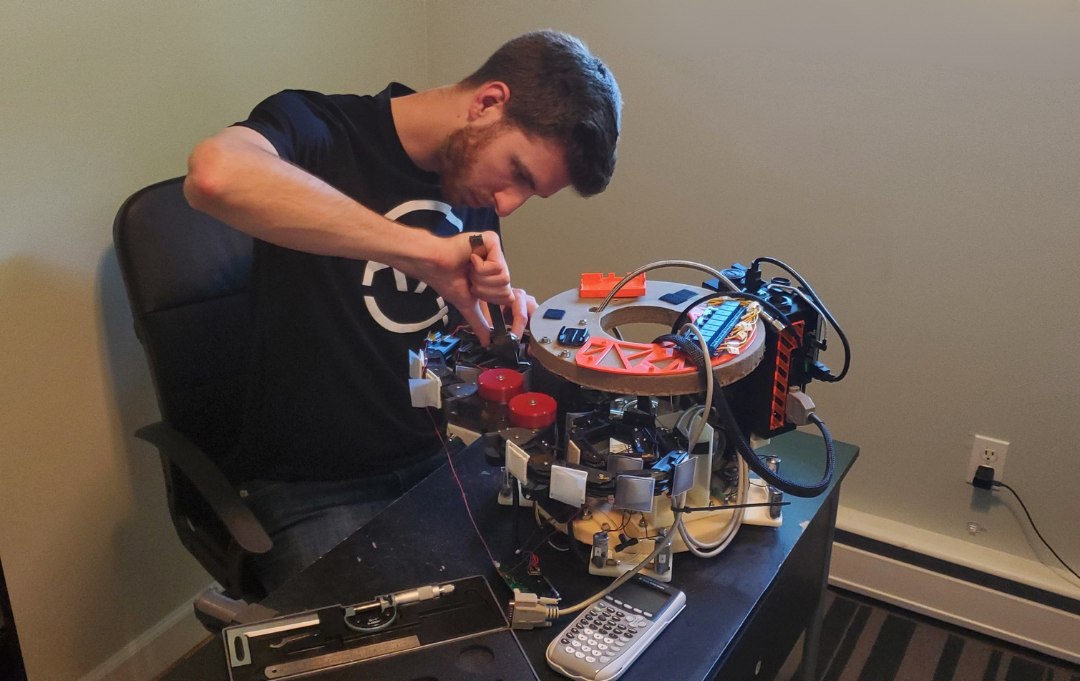
KMI Co-Founder & CTO Austin Morris with early iteration of REACCH (KMI)
Jumping ahead, after several years of research and development, and further iteration of REACCH prototypes, KMI had finally secured significant external validation and support when we won our first contracts from the US Space Force Orbital Prime initiative. This funding allowed KMI to conduct further development, which eventually led to our sponsorship from the Center for the Advancement of Science in Space (CASIS) and partnership with the ISS National Laboratory. With all the contracting completed, signed with dotted i’s and crossed t’s, in October 2023, the timer truly began.
Over the next several months, our Engineering team kicked things into high gear (only metaphorically speaking, REACCH doesn’t exactly have a high and low gear). The team focused on executing the most critical tasks, developments, and testing efforts to ensure that the payload had the highest possible chance of success. When we embarked on this journey, with a plan to deliver our hardware some nine months later to launch aboard SpX-31, many people with much more experience and knowledge told us to expect a much longer lead time to delivery than we had planned, calling our planned schedule “aggressive” more times than I could count (because it was a lot of times, to be clear, not because I can’t count very high). We acknowledged the risk and the likelihood that we may not make it in time. This gamble would mean any delays would simply slip our payload to the next available launch, leaving us no worse off than if we had simply planned for a longer lead time in the first place. KMI remained determined to keep the nearer-term possibility alive.
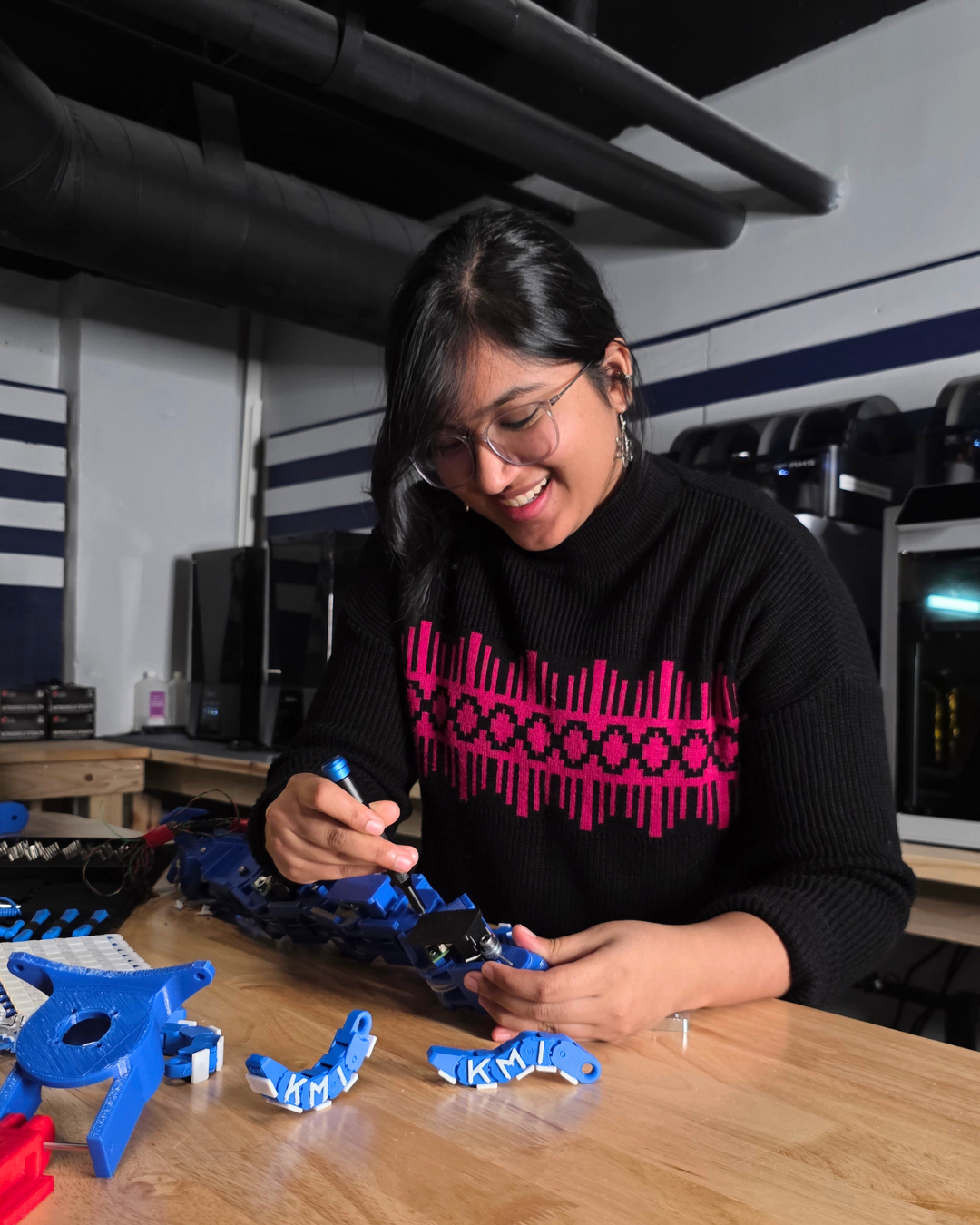
Robotics Engineer Preksha Madhva (KMI)
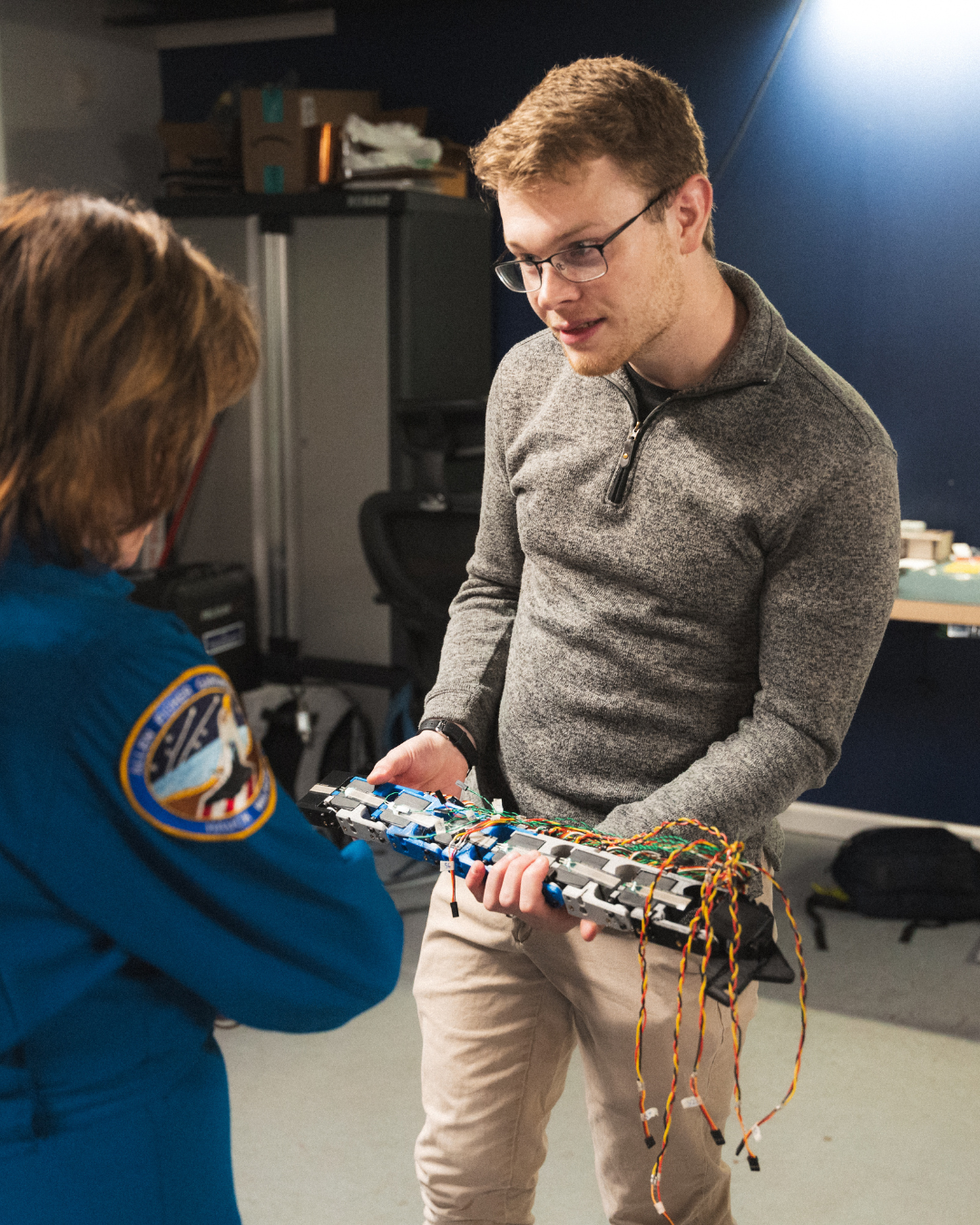
Electrical Engineer Thomas Ziegler (Ryan Stephens Photography)
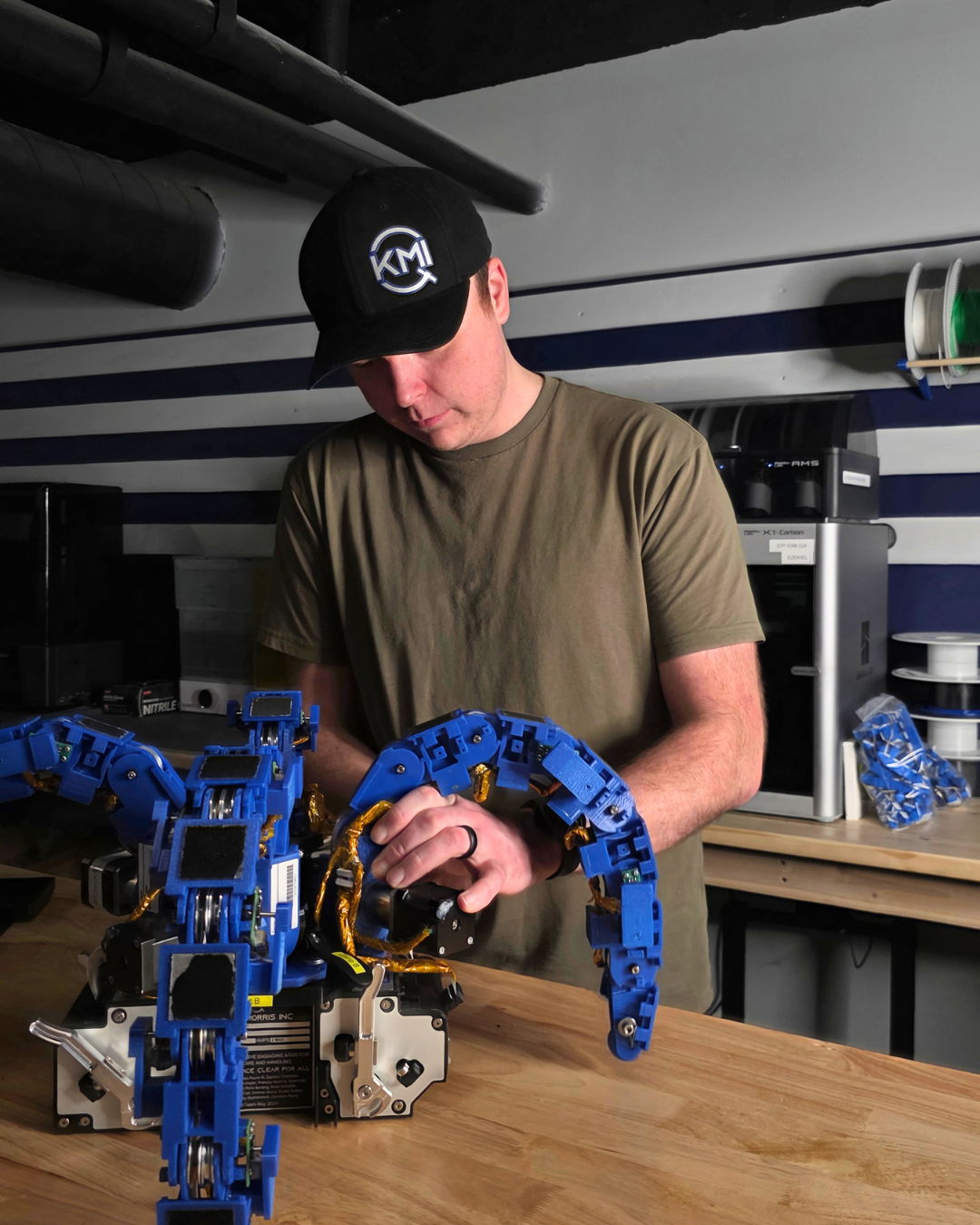
Head of Engineering Sam Cassidy (KMI)
The process was intensive, detailed, and admittedly exhausting. Our Engineering team, myself included, spent many long hours preparing, testing, correcting, adjusting, retesting, and validating that our systems would be ready to go for ISS testing. With a focus on rapid iteration for the quick identification of any issues, our team was able to just as rapidly fix them before moving on to the next set. The first and most significant kick in the pants was when we sent two of our team members, Sam and Preksha, out to visit NASA Ames Research Center with our prototype hardware to plug it into a terrestrial Astrobee unit for integration testing. In the few days they were out there, dozens of different things were found to be catastrophically nonfunctional. As this was our first time “showing off” this hardware to an external party, and to folks at NASA no less, it was a bit of a harrowing experience to realize that this prototype - that had more or less been our baby for months - just plain didn’t work as expected.
Not to be discouraged, though, we spent those days troubleshooting with NASA, and when Sam and Preksha returned, the team had a list of numerous items to resolve. By the time we took REACCH to the next round of testing, less than a month later, we had solved every single one of those problems, and boom, just like that, we had all new problems. After a few cycles of this, ultimately concluding with three trips to NASA Ames, Mountain View, CA, and one to NASA Johnson, Houston, TX, both ourselves and our NASA partners were finally convinced that all problems were resolved and that REACCH was ready for launch. KMI handed over the REACCH payload to our implementation partner, Nanoracks (now Voyager) in July 2024, and we then prepared to watch the hardware lift off and leave terra firma in a few short months.
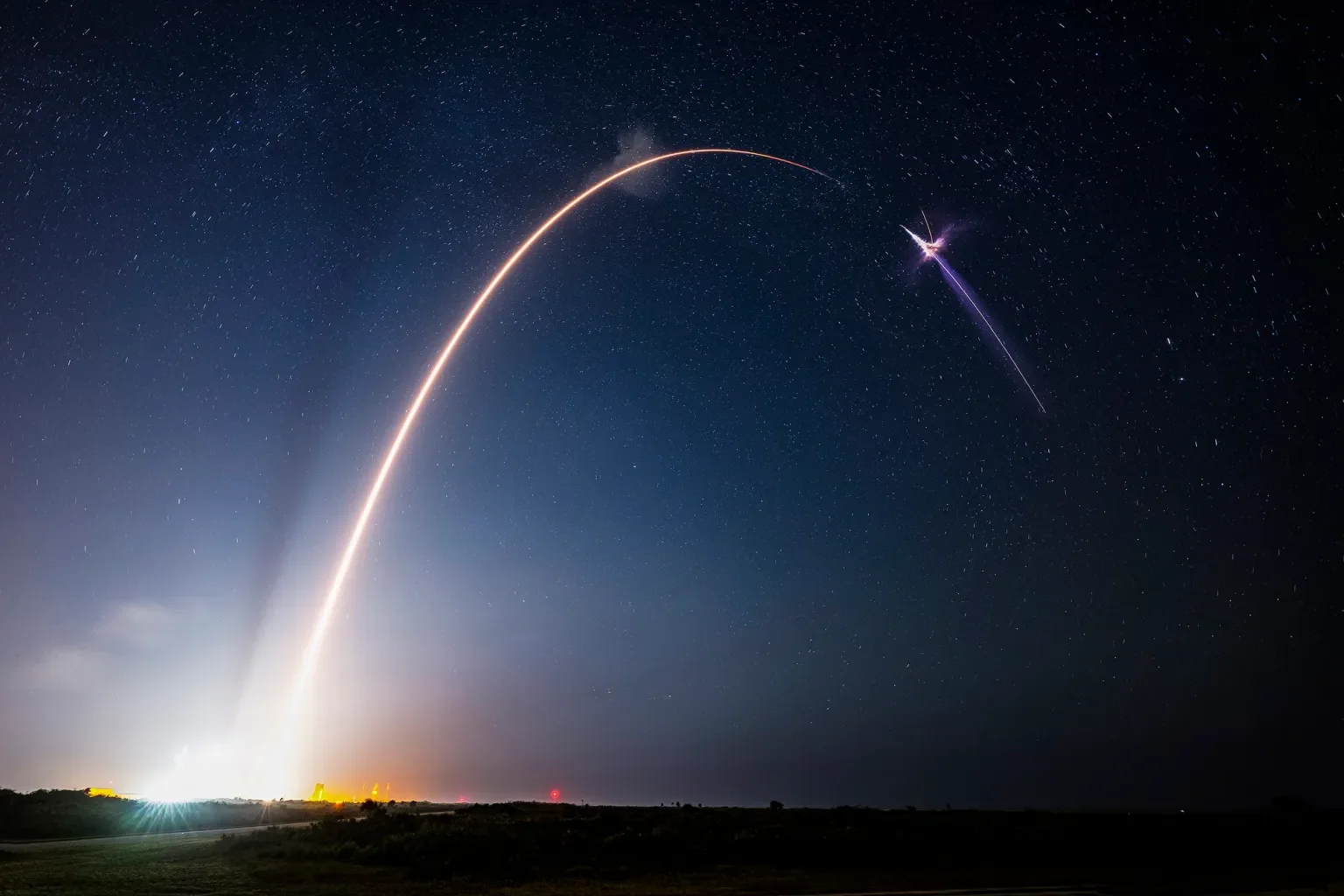
Watching the countdown to launch filled our whole team with a complex mix of emotions, from excitement at the upcoming launch to abject terror at the prospect of it going wrong, and even to relief that at least it was all out of our hands at this point. Seeing SpX-31 sitting on the launchpad at Kennedy Space Center, prepared to fly from the historic launch complex 39A, filled me with feelings I still find somewhat indescribable. Knowing that this was the same launchpad that had first sent humans to the moon, first sent our advisor, Dr. Anna Fisher, to orbit aboard a Space Shuttle, and so many other significant events in both space and human history gave a quiet reverence to the significance of this moment.
The emotions peaked at 9:29 pm Eastern time on November 4, 2024, as our team, loved ones, and supporters watched that rocket ride a pillar of fire and smoke into the sky, carrying all our hard work on board, sustaining even 12 hours later when the capsule docked with ISS at 9:52 am Eastern the following morning.

KMI team and loved ones watching the SpX-31 launch virtually from headquarters in Marquette, Michigan (KMI)
As a company built and operating in a hybrid of remote and in-person settings, I’ll never forget joining most of our team in the main office with a projector set up to watch the launch together. Those who couldn’t be there in person with us were some of our remote team members who joined us online for a group watch, as well as Rose and Mike, who were lucky enough to watch the launch in person with Dr. Fisher. I’ll never forget the energy leading up to it, nor my gratitude to our newest employee (launch day was literally her first day working for KMI) for breaking the silence to get us all celebrating a few seconds after liftoff, even though I was still holding my breath until we were through Max Q.
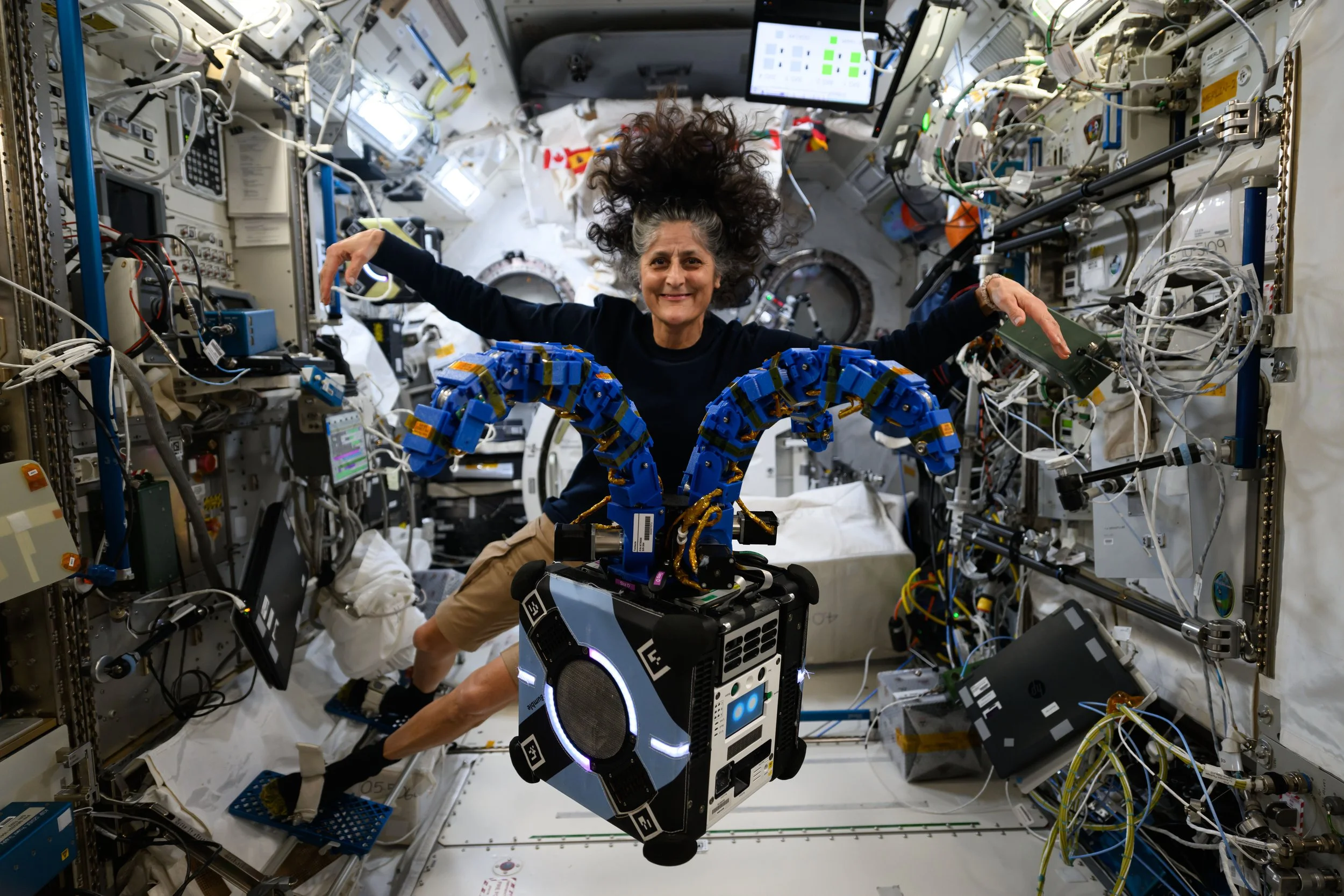
Once aboard ISS, REACCH underwent a great many things, from being stowed to being lost, then found, set up, tested, torn down, re-stowed, and on and on again. Over the course of six testing sessions, spaced throughout a little less than 5 months, we had the enormous pleasure to work with amazing crew members. Astronaut Suni Williams was our crew partner on the first four of those sessions, Butch Wilmore on the fifth, and both Don Pettit and Takuya Onishi on the final session. When we originally set out on this demonstration mission, our primary objectives were to install the hardware, calibrate it, and conduct at least 10 capture cycles to get a performance baseline that would help us understand how the tentacles behaved in microgravity when interacting with a free-floating object. After all sessions concluded, we finished at a total of 172 capture cycles, covering numerous different variables, parameters, and capture scenarios, giving us a phenomenal amount of data and reference for how this hardware behaves in orbit.
In conducting these demonstrations, we achieved several notable things, including becoming the first commercial company to capture an unprepared object in space and the first private company to capture objects repeatedly in space. In terms of the REACCH payload specifically, it ranked as the largest ever flown Astrobee payload by both mass and volume, as well as the highest power draw payload ever flown on Astrobee. Remarkably, it was prepared and delivered by our incredible team of KMI Space Rangers in approximately half the time of a typical Astrobee payload (which at the time was two years, though the new sustainers of Astrobee, Arkisys, have focused a lot on streamlining that process).
Our specialists in Michigan had the opportunity to collaborate with spectacular teams at NASA Centers in California (Ames Research Center), Texas (Johnson Space Center), and Alabama (Marshall Space Flight Center), as well as the incredible crew in Low Earth Orbit (International Space Station). As incredibly gratifying, humbling, and inspiring as the experience was, all good things must eventually come to an end. By the time REACCH splashed down on May 25, 2025, it had spent just over 200 days in orbit around this big blue marble we all call home. It took a little over a month for the hardware to be processed through the necessary steps and ready for retrieval, with me flying down to Houston to personally pick it up and fly it back to Marquette, returning home on July 4, 2025.
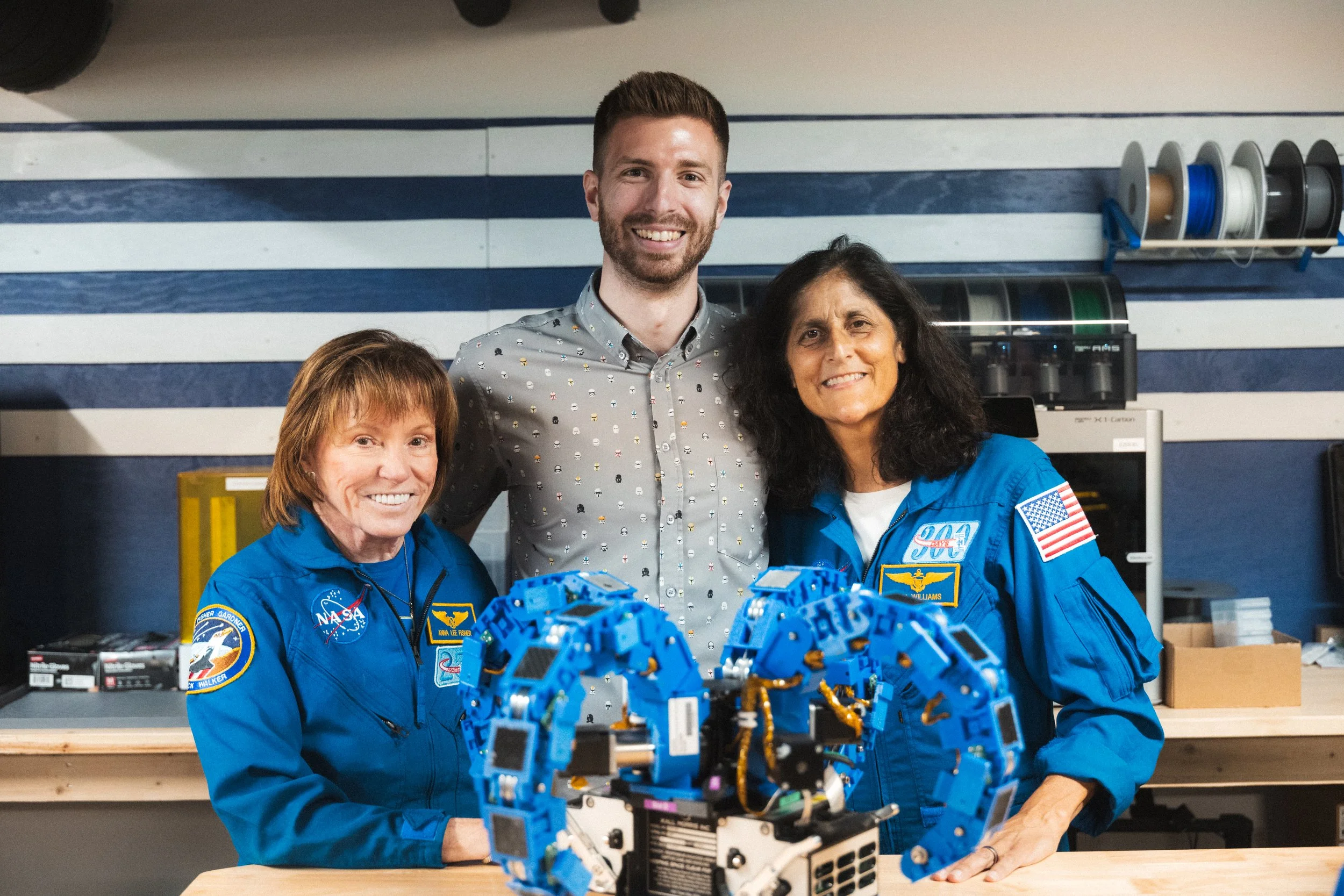
Austin Morris with Dr. Anna Fisher and Sunita Williams, celebrating the return of REACCH to KMI headquarters (Ryan Stephens Photography)
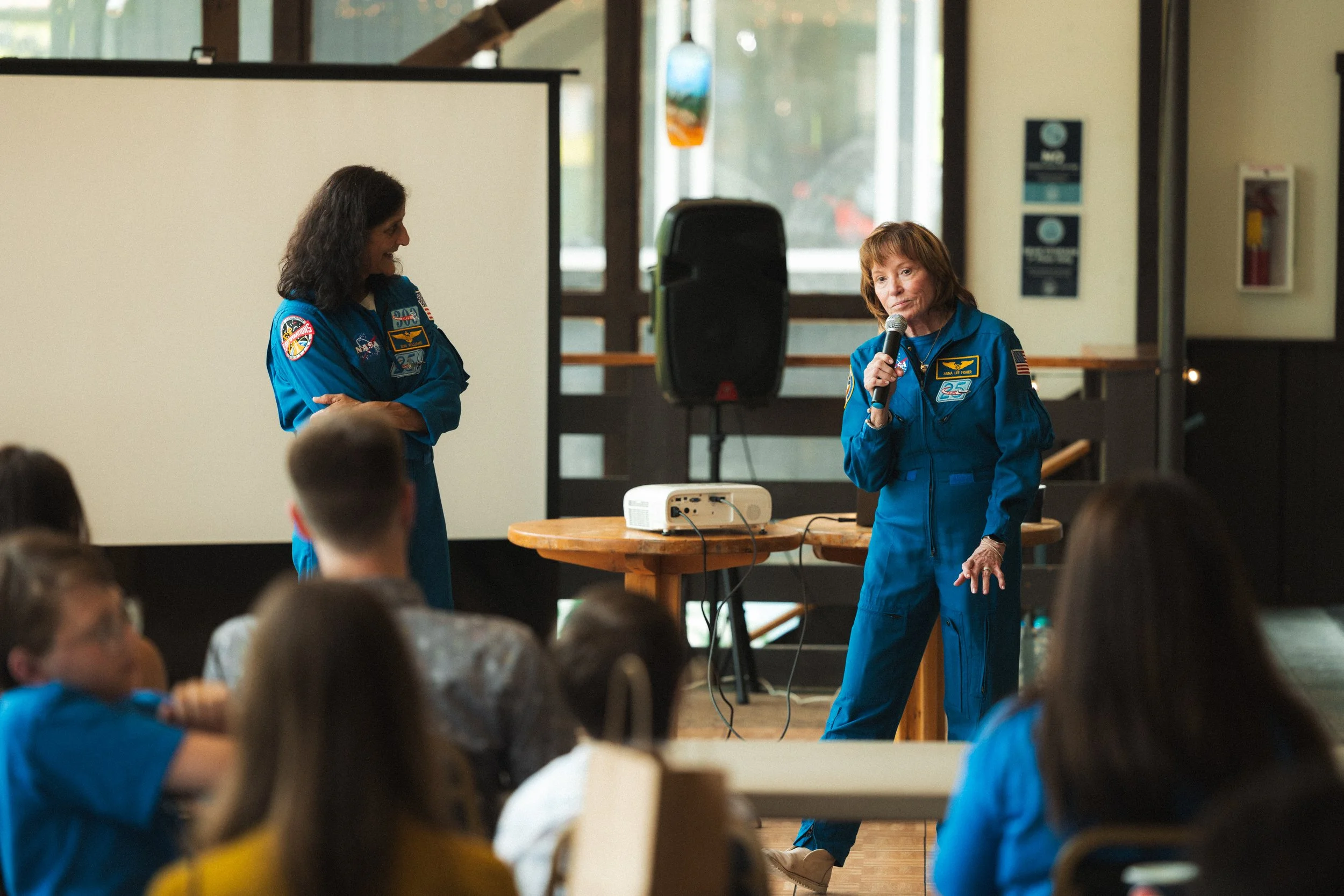
Only two weeks later, KMI was fortunate enough to be able to host the two astronauts with more hands-on experience in capturing in-space objects than any other humans in the universe: Dr. Anna Fisher, our advisor who flew on STS-51A, and Commander Suni Williams, who had spent around 24 total hours operating REACCH on the ISS. Suni and Anna visited the Marquette area on July 14, 2025, meeting with the KMI team, touring our humble facility where we built, tested, and operated the equipment, and interacting with the REACCH hardware for the first time while under full Earth gravity. They also met with local students, answered questions, and talked about their past experiences, likely inspiring a whole new generation of astronauts, explorers, researchers, science communicators, space artists, and more. I remain incredibly grateful to them both for their time and to the NASA Astronaut Appearances Office for their phenomenal work in curating and coordinating such an incredibly valuable experience for so many.
After taking the appropriate time to celebrate the wins, to reunite Suni and REACCH, and to finally catch up on sleep for the first time in a few years, the KMI team got straight back to work. There is much yet to come, with work conducted since REACCH’s return to validate simulations by matching them up to real-world data from orbit, further continued iteration to keep improving mechanics and motion of the technology, and preparation for a full spacecraft mission on the horizon. This ongoing work emphasizes the same basic things that our prior work did, including engineering excellence, scientific forethought, rigorous analysis, R&D, and testing.
Our team remains focused on proving that when we set out to do things, even if they seem impossible, unlikely, or impractical, KMI will challenge those assumptions, overcome adversity, and accomplish the mission in record time. After all, the difficult we can do immediately, the impossible just takes a little longer.

KMI Team with Dr. Anna Fisher and Sunita Williams during REACCH Reception in Marquette, Michigan (KMI)
There are several big things coming for the continued development of REACCH, and the spacecraft that it will fly upon, Laelaps. The KMI team is working diligently to prepare for our next demonstration, which will fly to space in the near future and go beyond the ISS, out into the vastness of space, to showcase KMI’s ability to retrieve and relocate objects in Low Earth Orbit. Stay tuned to KMI Columns, social media, and in-person appearances in the coming months to keep up to date on the progress of our journey toward the mission of #KeepingSpaceClearForAll.
Recommended column to read next: Electronics Design Considerations for an Astrobee Payload: Robustness