Servicing Data Centers in Space
Servicing Data Centers in Space
Adam Kall, Chief Strategy Officer
5 minute read
Data centers have been an important piece of infrastructure for decades, and a recent uptick in demand from AI has strained the terrestrial limits of power grids and communities. As demand for computational power continues to rise, and viable locations for new data centers on Earth become harder to find, some technocrats are beginning to look to space. Whether there is one GPU-enabled satellite in orbit or millions, there are important logistical concerns to consider before processing massive amounts of data in space.

A data center requires a few core aspects to be functional. It needs hardware, which needs power, which generates heat that needs to be transferred away to not overheat the hardware, all so that the requests and answers can be transmitted to and from the users. Getting hardware into space is mostly a matter of launch capacity and cost, which many launch companies have been working hard to solve. This will be more expensive than building a data center on the ground, but once launched, the only ongoing costs will be ground station costs for communications and mission control of the satellites. While the terrestrial data centers are getting their power from local utilities, and often causing rates for the average consumer to spike without warning or recovery, the most reliable power source in space is pure, unfiltered sunlight landing on a satellite’s solar panels. That still leaves the issues of heat dissipation into a vacuum, but I’ll leave the thermodynamics for another time, as the magnitude of this issue goes far beyond the needs of a simple satellite.
Transmitting data is what satellites do all the time, so there won’t be huge issues there. The volume of data may exceed normal limits, but innovations like direct laser communications could resolve this problem in cases where it makes economic sense. This presents a financial puzzle for orbital data centers, which continues to be debated across social media, but the conversation is also missing a core complication related to the orbital mechanics of space and the human history of not cleaning up our mess.
The decision to power orbital data centers with solar panels can be described with almost child-like simplicity; Solar panels need the sun, and the sun is in space, so solar panels in space are happy. There is no atmosphere to get in the way and no sand or dust to deposit and reduce efficiency. However, due to the nature of many commonly used orbits, this does not mean that sunlight is always available. For nearly every low orbit around Earth, there will be a period in which the Earth itself blocks the Sun, during which time solar panels don’t work (night here on Earth is also the same situation, with the Earth blocking the Sun). A normal satellite and some terrestrial data centers solve this issue with heavy batteries and extra solar panels to charge those batteries, but this adds extreme costs to the already expensive endeavor of in-space data centers. The orbit could be made higher, so that the Earth can’t block the Sun entirely, but this would make the transmission and receiving of data much harder and also more costly than operating at a Low Earth Orbit (LEO). Even so, I said that “nearly” every orbit experiences shade, and the special case of an orbit that doesn’t is suddenly prime real estate.

If an orbit is around the equator (Equatorial), it will experience a constant shadow about 30%-40% of the time. It is then logical to think the solution would be a polar orbit, which would place the satellite in the Sun 100% of the time. This solution is not without its own problems: the Earth orbits the Sun. This means there will be some times of the year when that 0% shade becomes 30-40% again. What is needed is a polar orbit, which keeps the satellite drifting at the same pace as the Earth’s rotation around the Sun. This is known as a Sun Synchronous Orbit (SSO).
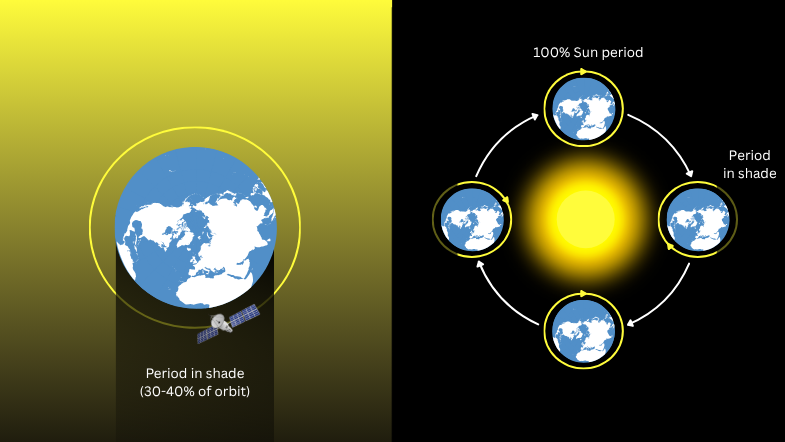
Periods of orbit in Sun and shadow (KMI)
SSO involves a particular inclination, slightly off from a perfectly polar orbit, that wobbles at the same pace as Earth’s orbit. If this exact orbit is then paired with another exact orbital parameter, the Right Angle of Ascending Node, or RAAN, then it will result in an orbit that is forever in sunlight, while the wrong RAAN will guarantee an orbit that forever has some shade.
So this location of Sun-aligned SSO LEO is prime real estate for orbital data centers. The only problem is that it has been prime real estate since 1957, when the first satellite operators realized it would let them skip on battery mass. This means it is completely full of operating space objects, defunct satellites that can no longer operate, and other space debris, so any dreams of these efficient data centers are going to have to involve missions to mitigate existing objects and risks in SSO. The irony is not lost on this author that terrestrial data centers are facing pushback over environmental problems on the ground, and the solution for satisfying/avoiding the protests is to move data centers to space, creating an environmental problem further away. The proponents of these orbital data centers are relying on the nature of humanity to ignore environmental issues they can’t see until it affects them personally. Those who do protest can be overcome by having their grievances resolved or, as is more often the case, being politically ignored or brutalized by police action. The “protesters” in space, existing as inert chunks of metal travelling over 17,000 miles per hour, cannot be intimidated by a legal notice or a few dozen hired thugs in body armor. The only resolution available is the responsible decision to clean up the mess, or else orbital data centers will just be a very expensive way to create more junk in space.
This necessary step of cleaning up the prime SSO is more affordable than many might expect, thanks to the grand scale at which the data center proposals seek to operate. If a truckload of supplies needs to be hauled across the US, then it would make sense to use a truck. If ten thousand truckloads need to cross the continent, a train is more efficient than a caravan of trucks, despite the initial cost of rail infrastructure. In the same way, the removal of a few debris objects would require a single servicing spacecraft, like a Laelaps spacecraft from KMI, but the removal of hundreds of debris objects would justify the infrastructure of orbital collection stations and standardized mass-production of Laelaps spacecraft, bringing the overall cost down. With the budgets for orbital data centers being measured in the tens of billions, the critical aspect of clearing the solar way would represent a low single-digit percentage of costs.
From an engineering and economics perspective, orbital data centers could be possible, but will require a realistic approach to problems that physics simply will not let be swept under a rug. Personally, I struggled in deciding whether to write this column or not, as I see orbital data centers as more expensive and complicated than terrestrial ones, with the idea seemingly used in a startup-like fashion to boost valuations by ignoring the expenses and only describing the revenues. Yet I ended up writing this column anyway, because this discussion isn’t about just data centers in space. It’s about any energy-intensive industrial activity in space, and whether we’re talking about data centers today or space factories tomorrow, I believe in a future where the unique environment of LEO will create a massive industrial potential for products and services that can’t be offered anywhere else. In all cases, the problem of cleaning up space is one that cannot be avoided. KMI has developed the technology for in-space logistics, which will enable both the cleanup and follow-up orbital logistics for any in-space industry at a commercially viable cost. If the relentless drive for more AI processing power is what finally pushes humanity to address the mess we’ve created, then at least something positive may emerge from it.
Recommended column to read next: KMI and the SDA TAP Lab